A Landscape That Feels Like Home, Even From Far Away
Imagine someone visiting Japan for the first time asks a simple question: what kind of landscape feels truly Japanese?
It is easy to answer with famous names. Mount Fuji. Kyoto. A temple roof. A quiet garden. A mountain with snow on its top.
Those answers are not wrong. They are probably the first images many people outside Japan already know. But they are only the entrance.
A Japanese landscape is not made only from a mountain shape or an old building. It carries a feeling that is harder to explain.
Sometimes a place feels familiar even if you have never been there before. You are still a traveler. You still have a phone in your hand. There are signs, tickets, maps, and people around you. And yet, for a moment, the landscape seems to know something older than your own memory.
In Japanese, the word furusato means hometown. But it does not always point to one actual address. Many Japanese people did not grow up near Mount Fuji. Many have never lived in Kyoto. Still, some landscapes seem to reach beyond personal memory and touch something shared.
That may be because the human world in these landscapes does not try to defeat nature. It sits inside it.
There is a mountain. There is humidity. There are seasons. There is a late afternoon light that is not very strong. Buildings are not placed against nature as a stage backdrop. Roofs, gardens, trees, and clouds all seem to belong to the same flow of time.
That is where the quietness comes from.
It is not the quietness of nothing happening. Clouds move. Leaves change color. Rain falls. Birds pass through the sky. Night comes. The scene is alive, but it does not hurry.
The quietness of a Japanese landscape is not stillness without movement. It is movement without haste.
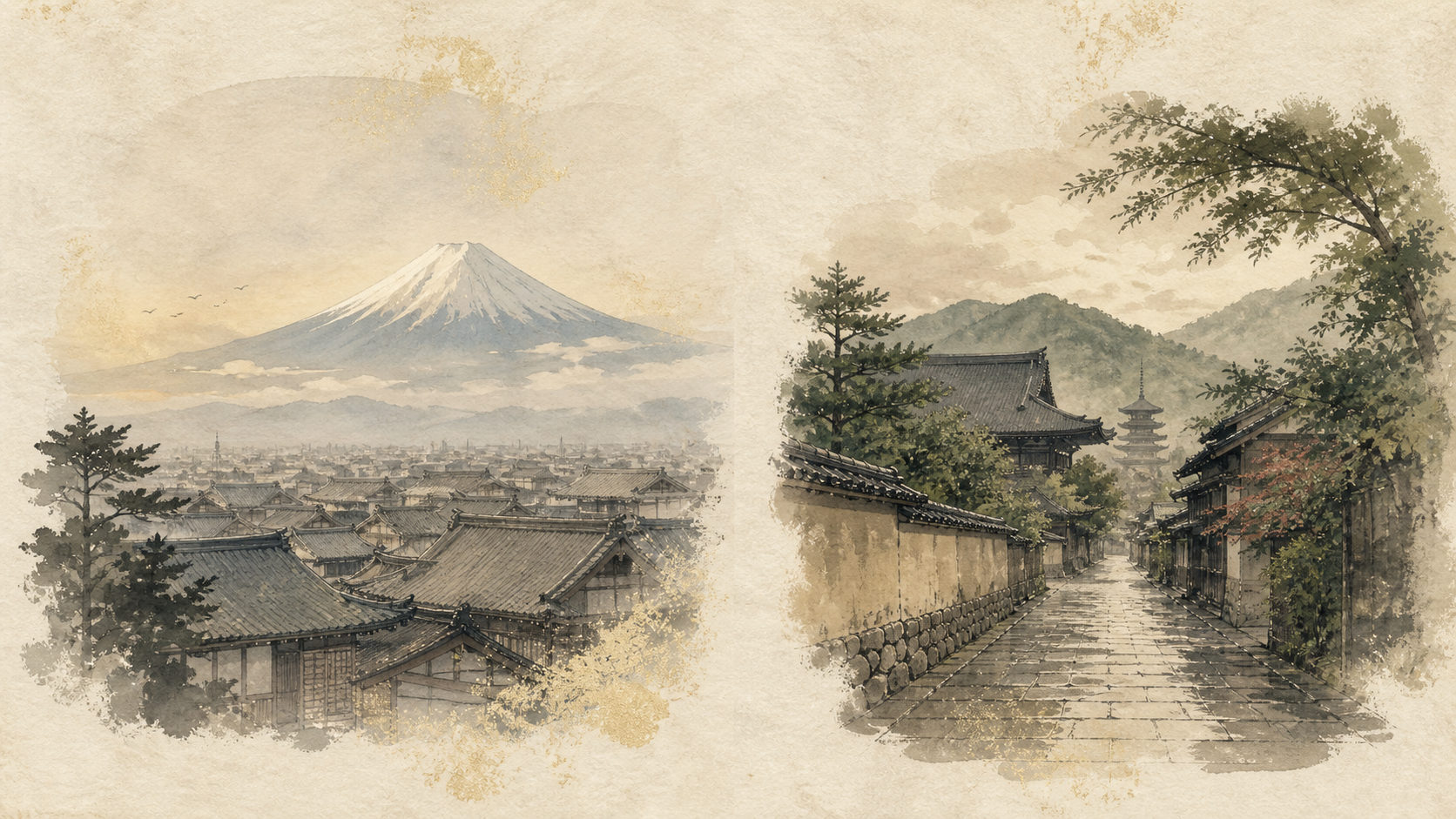
Mount Fuji: A Distant Mountain at the Center of the Mind
When thinking about that feeling, Mount Fuji is a natural place to begin.
For someone outside Japan, Mount Fuji can be introduced very simply: it is Japan’s tallest mountain, famous for its snow-covered cone. That explanation is useful. The mountain is easy to recognize. It fits into photographs, postcards, travel posters, and guidebooks.
But for many Japanese people, Mount Fuji has never been only a beautiful mountain.
It has long been a sacred place, an object of worship, and a source of art. People feared its eruptions. People prayed toward it. Pilgrims climbed it. Artists painted it again and again. The mountain exists in nature, but it has also been rebuilt many times in prayer, image, and language.
Today, many people climb Mount Fuji during the summer season. That can make it feel accessible, almost like a famous destination on a checklist. But for much of its history, Fuji was not simply a mountain to be climbed for leisure. It was a mountain with fire inside it, a place to be approached with fear, respect, and ritual.
It is also not a perfectly unchanged symbol. In 1707, the Hoei eruption sent volcanic ash as far as Edo, the city that later became Tokyo. The eruption created a new feature on the southeastern side of the mountain, now known as Hoei-zan. The mountain many people imagine as a symbol of permanence changed its form only a few centuries ago.
That history matters.
The quietness of Mount Fuji is not the quietness of something harmless. It is the quietness of something immense, powerful, and distant, standing in place while carrying the memory of fire.
Distance is important here.
Mount Fuji is often most powerful when it is not under your feet. It appears beyond a lake, beyond a town, beyond the road, beyond the life you are standing in. When you come close, it is of course a huge mountain. But from a distance, it becomes a place where your own time can be set down for a while.
Furusato has a similar quality.
It is not fully yours. You cannot hold it in your hand. You may not even live there anymore. But it remains somewhere beyond you, quietly receiving the changes in your life.
One pattern in Japanese scenery may be this: to value something far away without needing to possess it.
You do not conquer the mountain. You look up to it. You do not own the landscape. You let it remain at a distance. In that distance, the human self is placed back inside a larger natural time.
There is another historical layer as well. Mount Fuji could once be seen from Edo.
Many places in old Edo carried the name Fujimi, meaning “Fuji view.” Seeing the mountain from the city was not a rare spiritual abstraction. It was part of the urban imagination. As political and economic power moved from Kyoto to Edo, Fuji stood beyond the new city as another kind of axis.
If Kyoto carried the memory of the old capital, Mount Fuji gave the newer capital a distant sacred horizon.
That may be one reason Fuji has been drawn, looked at, and written about so often. Its beauty is not only its shape. It is also a place to put time.
Kyoto: The Old Capital That Still Remains a Capital
Kyoto is the other side of this feeling.
It is not primarily a distant view. It is a landscape you enter by walking.
Kyoto is widely known as Japan’s old capital. It began as Heian-kyo in 794 and remained a center of politics and culture for a very long time. Temples, shrines, gardens, machiya townhouses, narrow lanes, tiled roofs, and old walls all make it easy to introduce Kyoto as a place where “traditional Japan” can still be seen.
But Kyoto’s power does not come only from being old.
Kyoto was the capital for centuries, but it was also repeatedly exposed to war and political change. The Onin War devastated much of the city. Later rulers left their marks on it. Toyotomi Hideyoshi reshaped parts of the urban structure. In the Tokugawa period, Nijo Castle was built as a place of authority inside the old capital.
Kyoto is therefore not simply a preserved city.
It is a city that was damaged, rebuilt, ruled, rearranged, and overwritten, while somehow keeping the atmosphere of a capital.
That is a rare thing.
When political power moved to Edo, and later to Tokyo, Kyoto could have become only a former capital, a museum of lost centrality. But it did not disappear into the past. Even after yielding the practical functions of the capital, it continued to hold a kind of dignity. It remained, in the imagination, one of Japan’s capitals.
This is why seeing Kyoto only as a collection of old buildings misses the point.
The beauty of Kyoto is not completed by buildings alone.
Cherry blossoms in spring. Deep green in summer. Red leaves in autumn. Snow on a roof in winter. A temple roof, a garden’s empty space, a mountain behind the city, moist air after rain. The building is not a single object displayed against nature. It becomes a vessel that receives the season.
Japanese wooden architecture is not like stone architecture that tries to hold eternity in one fixed form. Wood is vulnerable to rain, humidity, fire, and time. It must be repaired, replaced, and cared for. Something is lost, then restored. Something old is used again.
Because of that, the past in Kyoto does not feel completely frozen.
It returns to the present through light, rain, wind, and use.
Here, Kyoto and Mount Fuji meet in a deeper way. In both cases, the human world does not stand proudly above nature. It receives natural change and continues inside it.
In Kyoto, that feeling appears close to the body.
You turn a corner. A roofline appears. A tree moves behind a wall. Stone pavement is slightly wet. Beyond the famous temples and crowded sightseeing routes, there is another Kyoto made of small edges, gaps, surfaces, and seasons.
Time seems layered there.
Not because the city is a simple survival from a thousand years ago. It is not. There have been fires, wars, modernization, tourism, and reconstruction. But the habit of repairing old things, using them again, and returning them to the season gives Kyoto its depth.
A Japanese landscape can feel like home because it does not show only a completed past. It shows a past that is still continuing.
The Shared Pattern: Placing Human Life Inside Change
The common thread is not one particular shape.
It is not only Mount Fuji’s cone. It is not only Kyoto’s temples.
Those shapes matter, but they are entrances. What they lead to is the feeling that human work, memory, and prayer are placed inside natural change.
A mountain is seen from far away. A city is walked through season by season. Nature is not only the background. It is part of the meaning.
Japan’s climate makes this especially visible. There are four seasons, humidity, rain, typhoons, earthquakes, and fires. Wooden buildings age. Gardens change. Light changes. Nothing stays untouched. So the feeling of preservation is often not about freezing something forever. It is about repairing, receiving, and letting the old thing return to the present.
This feeling does not belong only to Japan.
But in Japanese scenery, it is unusually easy to see. Human things are not isolated from natural time. They are placed inside it.
That may be why such landscapes can feel calm even when their histories are full of change.
They invite you to breathe at a slower speed.
They do not say, “Look at what we have conquered.” They say, more quietly, “This too has passed through time.”
A Japanese Landscape on Your Desk
Wakeikoku is a quiet landscape desk clock app for iPhone. It takes scenes such as Mount Fuji and Kyoto and treats them not as static backgrounds, but as landscapes that change with time.
Morning, day, evening, night.
Mist, birds, seasonal colors, stars, and moonlight.
The idea is not only to look at Japanese scenery. It is to place a slow piece of Japanese time on your desk.
If Mount Fuji or Kyoto makes you feel something beyond ordinary sightseeing, that feeling is close to the entrance of Wakeikoku.
Wakeikoku - Japanese Ambient Scenery
Related Reading
- Why the Tide at Miyajima Falls So Far | Seto Inland Sea Tides
- Wakeikoku Articles: making-of, wadokei, and quiet time
References
- Mt. Fuji World Heritage Centre: Object of Worship, Source of Art
- UNESCO World Heritage Centre: Fujisan, sacred place and source of artistic inspiration
- Cabinet Office, Government of Japan: Report on the 1707 Hoei Eruption of Mt. Fuji
- Japan National Tourism Organization: Historic Monuments of Ancient Kyoto
- Kyoto City: Overview of Kyoto City

Wakeikoku
Keep a Quiet Japanese Scene on Your Desk
Wakeikoku turns your charging iPhone into a calm Japanese landscape clock with washi textures, ink scenery, stars, moon phases, and a modern wadokei mode.